We've all seen organisations gradually limit their future options.
Not through one decision—but through many individually reasonable decisions.
What if that loss of future flexibility could be understood while meaningful alternatives still remained?
That is exactly the kind of decision situation Cascade Engine is designed to analyse.
See how a structured decision situation can be represented and compared.
The example below illustrates how two configured decision situations can be modelled and analysed.
Its purpose is not to predict the future.
It shows how a structured comparison can be made from information explicitly represented in the model.
What this showcase demonstrates
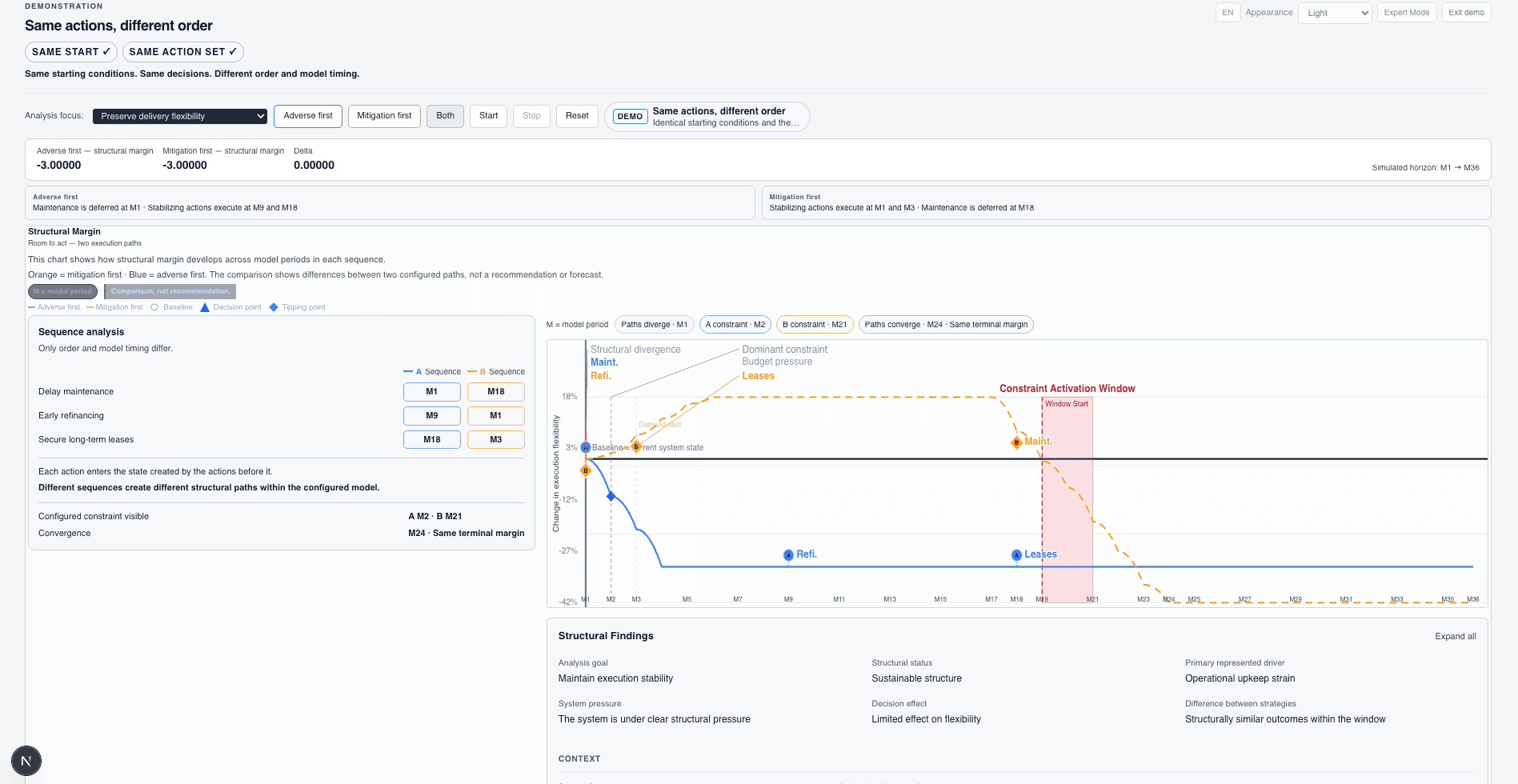
This showcase illustrates a structured comparison between two modelled decision situations.
Cascade Engine makes differences between the alternatives visible based on the decisions, dependencies and constraints explicitly represented in the model.
Cascade Engine interface
What Cascade Engine does
Cascade Engine is a deterministic analysis engine for decision situations where multiple decisions, dependencies and constraints are structurally connected.
The engine compares explicitly configured alternatives and shows how their structural conditions differ over time. Those differences provide insight into how the organisation’s future room to act may be affected within the represented model.
Within a configured model, Cascade Engine can compare the same starting conditions and actions in different orders or at different times, showing where the modelled paths diverge and whether they later converge.
It can make visible:
- when represented constraints become active,
- how shared capacities differ across configured alternatives,
- which dependencies, constraints and drivers contribute to the differences,
- and how the structural conditions of the alternatives develop over time.
Cascade Engine does not predict organisational outcomes.
It does not determine which decision is correct.
It provides a structured basis for executive discussion and judgement before important commitments are made.
What you provide
You don’t start with a large data-integration project.
You start with a decision situation.
Every model is developed together with the organisation.
The organisation provides domain expertise. Cascade Engine provides the analytical structure.
Relevant decisions, alternatives, dependencies, constraints, capacities and assumptions are identified and reviewed before the alternatives are analysed.
Typically, the analysis begins with:
- important decisions that are still open,
- realistic alternatives,
- relevant dependencies,
- represented constraints,
- shared capacities,
- assumptions that can be reviewed with domain experts.
What you receive
The analysis provides:
- a structured representation of your decision situation,
- a comparison of alternative decision structures,
- visibility into represented dependencies and constraints,
- an explanation of which modelled factors contribute to the differences,
- a structured basis for executive discussion.
The analysis provides a basis for discussion—not a recommended decision.
Executive judgement remains a human responsibility.
Why this analysis asks a different question
Every analytical approach begins by deciding which question it is trying to answer.
Decision Space Analytics begins with this question:
How do today’s decisions change what remains possible later?
Rather than beginning with predicted outcomes, Decision Space Analytics examines how explicitly represented decisions, dependencies, constraints and capacities reshape what remains possible within each modelled alternative.
Decision Space Analytics defines the analytical question and principles.
Cascade Engine provides the structured representation, comparison and analysis.
Understanding the complete analytical framework is not the first step.
The first step is understanding one concrete decision situation.
A first pilot is intentionally small.
A pilot focuses on one concrete decision situation—not the entire organisation.
Typical scope:
- 2–4 workshops
- approximately 10–30 represented initiatives
- decision owners and domain experts
- no large data-integration project
- structured analytical deliverables
Are you facing several decisions that affect the same resources, dependencies, or timeline?
Book an initial conversation about the decision situation and the relationships, constraints, or implementation sequences that need to be made visible before decisions are made.
Book an initial conversation